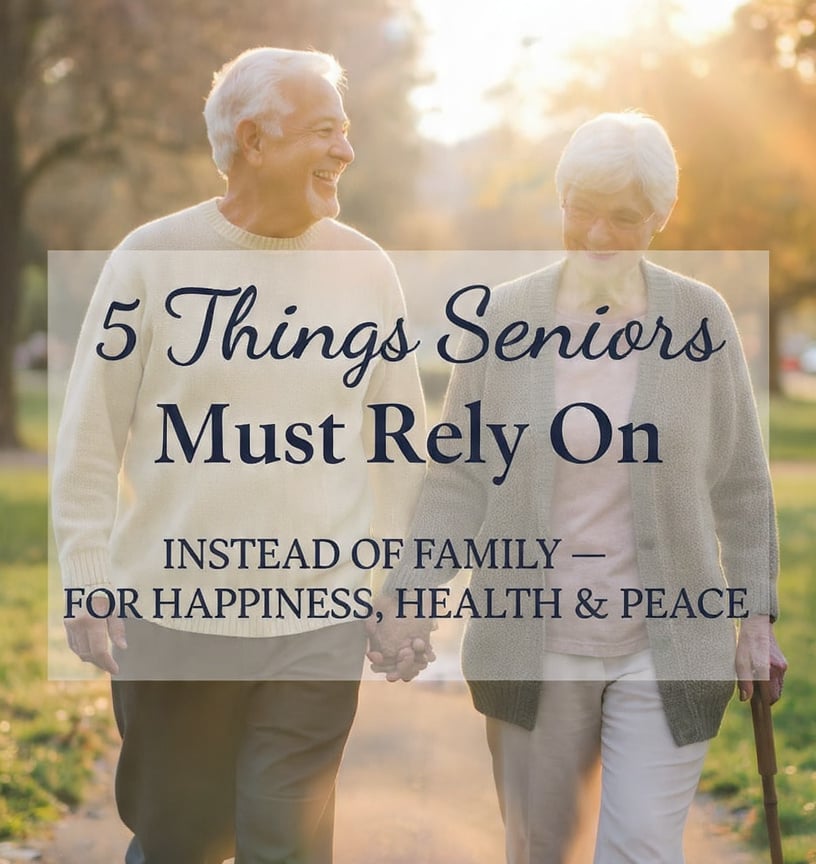
The 5 Things Seniors Must Rely On Instead of Family for Happiness, Health and Peace
Discover the 5 most powerful things seniors should rely on instead of family to find true happiness, health, and peace. Learn how purpose, friendships, gratitude, and routine can bring joy and stability in your golden years. Read more at HopeInEveryday.com — your daily source of encouragement and healthy living for seniors.
Javed Niamat
10/31/20256 min read
Introduction:
In our later years, many of us assume that family will provide the bulk of our happiness, health and peace. And often they do—but leaning solely on children or relatives can leave older adults vulnerable when life circumstances change: a move, a loss, a declining health condition, or even shifting family dynamics. The good news: real joy, wellness and inner calm for seniors increasingly come from five other pillars. These aren’t replacements for family; they complement them—and sometimes they may even carry more weight when family is distant, busy, or under strain.
At HopeInEveryday, we believe each person—no matter age—can cultivate resilient happiness, sound health, and deep peace. Let’s explore the five key foundations that seniors should actively rely on, and how they can begin today.
1. A Sense of Purpose & Meaning
One of the strongest predictors of wellbeing for older adults is having a sense of purpose—something beyond “just getting by.” A landmark study followed older adults over years and found that those who felt their lives were meaningful tended to live longer and experience better health. (TIME)
Why it matters
When family is the only focal point, seniors can feel their value declines once caregiving roles end or children move away. But purpose gives them a reason to wake up with expectancy, not just routine. Purpose may come from volunteering, mentoring, hobbies, spiritual service, or learning something new. A community-dwelling older adult study found that self-care ability and quality sleep were strongly linked to happiness. (BioMed Central)
Human touch
I recall meeting Mary, age 73, who had lost her husband and whose children lived out of state. She started volunteering at a local library: greeting visitors, reading stories to children, organizing a book club. She told me: “When someone says, ‘Thank you, you made my day,’ I know I still have something to give.” That gave her renewal.
Action steps for seniors
Make a short list of “What I still enjoy / What I could teach” — maybe gardening tips, story reading, music.
Choose one weekly commitment (even 1 hour) where you’re not the receiver but the giver.
Write a “purpose-statement” (6-10 words) you repeat: e.g., “I bring joy through stories and listening.”
Review every 3 months: Is this activity still meaningful? Do I feel energy from it or is it draining?
2. Consistent Physical Activity & Self-care
Good health, of course, underpins happiness and peace. Research finds that older adults with better self-care ability and sleep quality have significantly higher happiness scores. (BioMed Central)
Why it matters
Family may help with errands, company, or medical care—but they cannot be your body’s daily movement, your restful sleep, or your nutrition. Recognizing self-care as a responsibility rather than a burden empowers seniors. Physical activity helps mobility, mood, prevention of disease—and thus independence.
Human touch
I remember John, 68, working as a retired pastor. He said: “I used to think when the kids and grandkids come I’ll feel alive. But I realized I feel alive when I walk the trail, when I stretch, when I reach up and touch the sky.” He added a 20-minute brisk walk, 3 times a week, and said what changed wasn’t just his legs—it was his outlook.
Action steps for seniors
Choose a physical activity you like (walk, yoga, water aerobics, dancing). Aim for consistency, not intensity.
Set two non-negotiables: e.g., “I walk at 9 am Monday/Wednesday/Friday.”
Incorporate self-care rituals: bed at same time, gentle stretching in morning, water intake, check-ups.
Keep a small weekly “health diary”: mood, sleep quality, energy levels. Review monthly.
3. Meaningful Friendships & Broad Social Network
While family is precious, research shows that friendships and non-family social bonds are especially powerful predictors of happiness and well-being in older age. (TIME)
Why it matters
Family relationships can become complex: responsibility, expectation, caregiving roles may overshadow joy. In contrast, friendships are often freely chosen, fun, flexible. Seniors who invest in peer relationships often feel more fulfilled, less isolated. One community‐based Iranian study found social support significantly correlated with happiness among older adults. (PMC)
Human touch
Evelyn, now 75, lives alone but has a tight circle of friends from her book club and weekly painting group. She laughed: “On Tuesdays I know I’ll giggle, spill tea, and paint wild flowers. I don’t wait for family Sunday dinner—I circle up with my friends and feel alive.”
Action steps for seniors
Make a list of three friends/peers you enjoy but haven’t seen recently—reach out this week.
Join one new group or club this month (hobby, faith‐group, walking-group).
Schedule a “friend date” once every two weeks (coffee, game, walk).
Reflect: after each social time, ask: Did I feel uplifted? Did I smile more? Less alone?
4. Inner Peace through Mindfulness, Gratitude & Spiritual Grounding
Happiness and health aren’t just external; peace comes from internal habits. Research shows mindfulness, positive thinking, and spiritual or contemplative practices enhance resilience, reduce stress, and support emotional balance. (Erickson Senior Living)
Why it matters
As seniors face loss, change, health issues or shrinking social roles, inner peace becomes an anchor. Unlike family availability, spiritual practices and personal habits are within one’s control. A recent study in rural Ghana with older adults found “inner peace” was central to their concept of a good life. (SpringerLink)
Human touch
I met Robert, age 80, who starts every morning with a 10-minute gratitude list and 5 minutes of deep breathing, despite limited mobility. He told me: “My body creaks, but my heart is quiet. When I thank God for one more dawn, I don’t feel alone.”
Action steps for seniors
Start each day (or end it) with 3 things you’re grateful for—write them down.
Practice a short mindfulness or breathing exercise (3-5 minutes) daily.
If you are religious or spiritual, dedicate regular quiet time for prayer/reflection.
When health or family issues stir anxiety—pause, take 3 deep breaths, say, “This moment is enough.”
5. A Financial & Routine Foundation for Stability
Peace and health flourish when daily life isn’t under constant strain. That means having a stable structure: predictable routines, financial awareness, and manageable habits. Research repeatedly links stability, routines and self-care ability to better well-being. (AZ Big Media)
Why it matters
While family may support in emergencies, relying solely on them for everyday stability can create vulnerability. Older adults who develop personal routines, financial oversight, and stable habits tend to have less anxiety, better sleep, and more autonomy. When routines or finances falter, stress increases—and that impacts both health and peace.
Human touch
Maria, age 72, keeps a simple weekly plan: Monday & Friday grocery/errands, Wednesday social club, Saturday call with a friend, Sunday nature walk. She said: “When my children were small I managed five schedules. Now that I’m older, I manage one schedule—mine—and that gives me freedom.”
Action steps for seniors
Build a simple weekly routine: e.g., wake, meal, walk, hobby, social contact, rest.
Set a monthly check‐in: review bank/expenses, health appointments, home safety.
If finances are a concern: connect with a trusted advisor or volunteer service that helps seniors review budgets/pensions.
Use routines not as rigid constraints but as supportive structure: for example, “Thursday morning is my hobby time” rather than “I must do X at Y.”
Bringing It All Together
These five foundations—purpose, self-care/physical activity, friendships/social network, inner peace/mindfulness, and stability/routine—create a resilient wellbeing framework that does not depend solely on family. Family remains invaluable—but when you have these pillars in place, your peace, health and happiness are more self-sustaining.
Imagine a day in the life of a senior grounded in these pillars:
They wake, take a moment of gratitude, breathe deeply (inner peace).
They enjoy a leisurely walk or gentle exercise (physical health).
Later, they attend a volunteer meeting or teach a small class (purpose).
They meet a friend for coffee, sharing stories and laughter (social connection).
They return home to a predictable evening routine, review finances or mail, and rest comfortably (stability/peace).
On such days, even if a family call doesn’t happen—or if their child is busy with their life—this person still carries happiness, health and peace from within.
Final Thoughts
Aging is not the losing of things—it’s the refining of what remains vital. And among the most vital things are our internal resources and practices: purpose that matters, bodies we move and care for, friends who walk with us, peace that breathes quietly through our hearts, and routines that support rather than constrain.
If you are a senior (or supporting a senior) reading this, I invite you: pick one of the five foundations you feel weakest in, and take one small step this week. It might be a 10-minute gratitude moment, a walk, a call to one friend, a short class, or writing a weekly plan. Then next week another step. Over time, these small steps build the firm ground beneath the feet of aging gracefully.
Here at HopeInEveryday, we believe every day offers hope for new habits, new connections, new peace. May your journey be rich and anchored—not just in family ties—but in these enduring foundations of your own making.
Blessings and purpose to you as you step into each new day.